
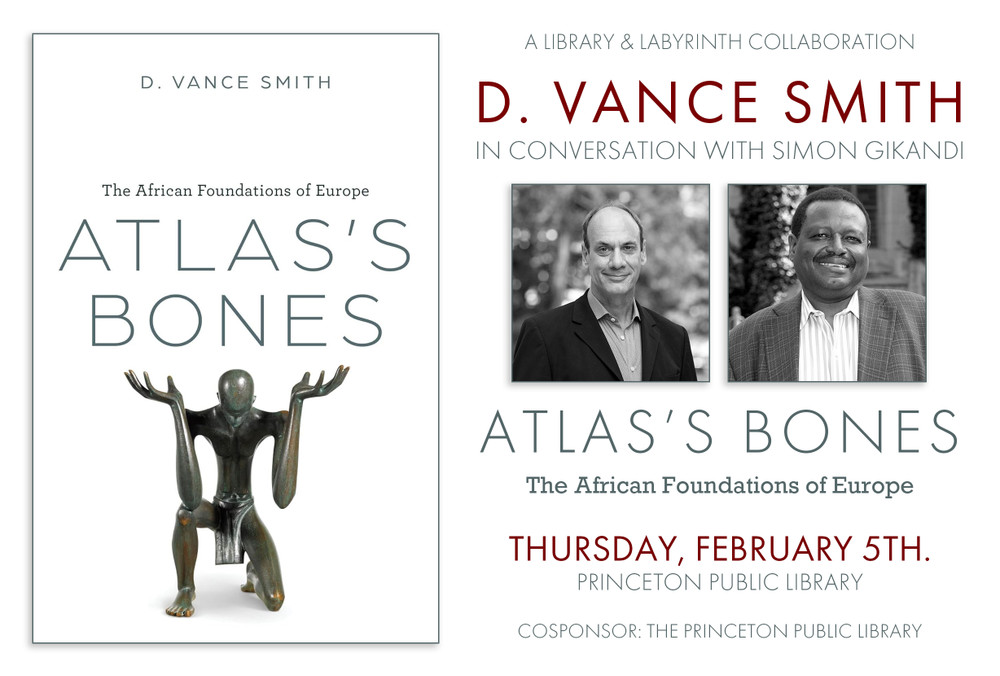
D. Vance Smith in conversation with Simon Gikandi: "Atlas’s Bones: The African Foundations of Europe" – A Library & Labyrinth Collaboration
Feb 5th 2026
Events @ Princeton Public Library
Thurs 2/5 @ 6:00PM
Princeton Public Library, 65 Witherspoon Street
D. Vance Smith, joined in conversation with Simon Gikandi, presents his new book Atlas’s Bones: The African Foundations of Europe. Reception to follow. Registration requested. Livestreamed to YouTube.
A link to the livestream will be made available on the library's YouTube page (click here).
Virgil. Chaucer. Petrarch. These names resonate with many as cornerstones of European culture. Yet, in Atlas’s Bones, D. Vance Smith reveals that much of what is claimed as European culture up to the Middle Ages—its great themes in literature, its sources in political thought, its religious beliefs—originated in the writings of African thinkers like Augustine, Fulgentius, and Martianus Capella, or Europeans who thought extensively about Africa. In fact, a third of Virgil’s Aeneid takes place in Africa. Francis Petrarch believed his most important achievement was his epic Africa, while Geoffrey Chaucer wrote repeatedly about the figures of Scipio Africanus, actually two different men who defeated and destroyed Carthage.
Smith tells the story of how Europe created a false “medieval” version of Africa to acquire resources and power during the era of imperialism and colonialism. The first half of the book traces Egypt’s, Libya’s, and Carthage’s influence on classical and medieval thinking about Africa, highlighting often ignored literary and legendary traditions, for example, that Alexander the Great named himself the son of an African god. The second half focuses on how the different cultures of the two great African cities—Carthage and Alexandria—shaped modern literary criticism and political theology and examines the cross-influences of modern anthropology, medieval studies, and colonial law.
Atlas’s Bones firmly re-establishes the significance of Africa in European intellectual history. It will be essential reading for anyone seeking to understand how much of Africa informs our artistic and cultural world.
D. Vance Smith is a professor in the English Department at Princeton University. His research bridges African and decolonial literature and theory, Africanfuturism, the history of anthropology, and the medieval roots of colonial structures, governance, and thought. His work also centers community engagement, community building, and radical pedagogy in Trenton, New Jersey, where he serves as the Board Chair of Trenton Artworks and as the Board Vice-President of Passage Theater. In Fall 2025, Smith co-taught the Humanities Sequence “Interdisciplinary Approaches to Western Culture” in the Program in Humanistic Studies.
Simon Gikandi is the Class of 1943 University Professor of English and Chair of the English Department at Princeton University, where he is also affiliated with the Departments of Comparative Literature and African American Studies and the Program in African Studies. Gikandi’s major fields of research and teaching are Anglophone literatures and cultures of Africa, India, the Caribbean, and postcolonial Britain; literary and critical theory; the black Atlantic and the African diaspora; and the English novel. His current research projects are on slavery and modernity, Decolonization and African Literature, and Global Modernism.
Presented in partnership with the Princeton Public Library and Princeton University's Humanities Council, Program in Humanistic Studies, and Department of English, with support from the National Endowment for the Humanities.