
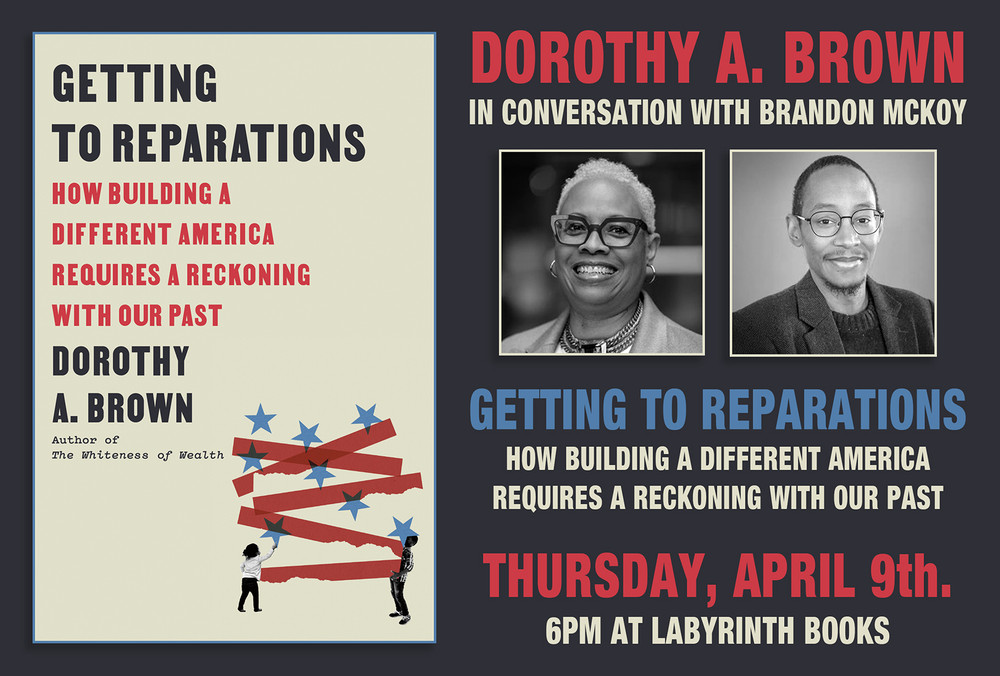
Dorothy A. Brown in conversation with Brandon McKoy: "Getting to Reparations: How Building a Different America Requires a Reckoning with Our Past"
Apr 9th 2026
Events @ Labyrinth Books
Join us as Dorothy A. Brown discusses her new book with Brandon McKoy. Getting to Reparations is a bold manifesto arguing that there is a clear precedent for paying reparations to atone for America’s original sin of slavery, offering a compelling legal strategy to achieve this goal from the acclaimed author of The Whiteness of Wealth.
The idea of reparations is not a new or original one; it is one that is baked into American history. When the District of Columbia Emancipation Act of 1862 went into effect, wealthy slaveowners like Margaret Barber were compensated for the loss of their enslaved workers. Barber received $9,000—an equivalent to $250,000 today. When a group of Italian immigrants were lynched in 1892, President Harrison compensated Italy a total of $25,000 for their deaths—an equivalent to almost $766,000 today. The Indian Claims Commission, an arm of the federal government, paid Indigenous Americans $818 million for underhandedly stealing their land in the eighteenth and nineteenth centuries—an equivalent to almost $350 billion today.
Dorothy A. Brown addresses the glaring question: if reparations can be achieved for others, why not for Black Americans? If lynching can be remedied for Italian immigrants, and slaveholders compensated for losses associated with abolition and emancipation, then the government’s failure to provide such remedies to Black communities harmed by similar violence, loss, and destruction is long overdue. The fight for reparations is truly a fight for the soul of America, to produce the country our founding fathers idealized but never achieved.
Getting to Reparations makes a logical and necessary case for reparations for Black Americans. It lays out a path as to how we might achieve this, built on the frameworks used throughout U.S. history by the government to pay restitution. It is now time to do the same for America’s Black population.
Dorothy A. Brown is a professor of law and the Martin D. Ginsburg Chair in Taxation at Georgetown University Law Center. She is also the author of The Whiteness of Wealth. A graduate of Fordham University and Georgetown Law, she received her LLM in taxation from New York University. A nationally recognized scholar in the areas of race, class, and tax policy, she has published dozens of articles, essays, and book chapters on the topic. She has appeared on ABC’s The View, CNN, MSNBC, PBS, NPR, The Armchair Expert, New Yorker Radio Hour, and Code Switch, and her opinion pieces have been published in The Atlantic, The New York Times, and The Washington Post. Born and raised in the South Bronx in New York City, Dorothy Brown currently resides in Washington, D.C.
Brandon McKoy is President of the Fund for New Jersey and an established leader in public policy analysis and advocacy statewide and nationally. He has worked as the Vice President for State Partnerships and Co-Leader of the State Fiscal Policy Division at the Center on Budget and Policy Priorities in Washington, D.C. Brandon is well known for his accomplishments from his time at New Jersey Policy Perspective, where he held several roles over the course of seven years before assuming leadership of the organization as NJPP’s President from 2019 through late 2021. Throughout those years, he researched and promoted a variety of issues including the minimum wage, paid sick leave, equitable taxation, public budget processes, the legalization and regulation of cannabis, and much more. Returning to The Fund for New Jersey in 2024 was a bit of a homecoming given that Brandon worked as a Program Associate at the organization and served as its first philanthropy fellow from 2012 to 2014. Brandon completed his bachelor’s degree at The College of New Jersey and earned a master’s degree from the Edward J. Bloustein School of Planning and Public Policy at Rutgers University.
This event is co-sponsored by Princeton's School of Public and International Affairs NJ, The Fund for NJ, New Jersey Institute for Social Justice, Princeton's Department of African American Studies, and Labyrinth Books.