
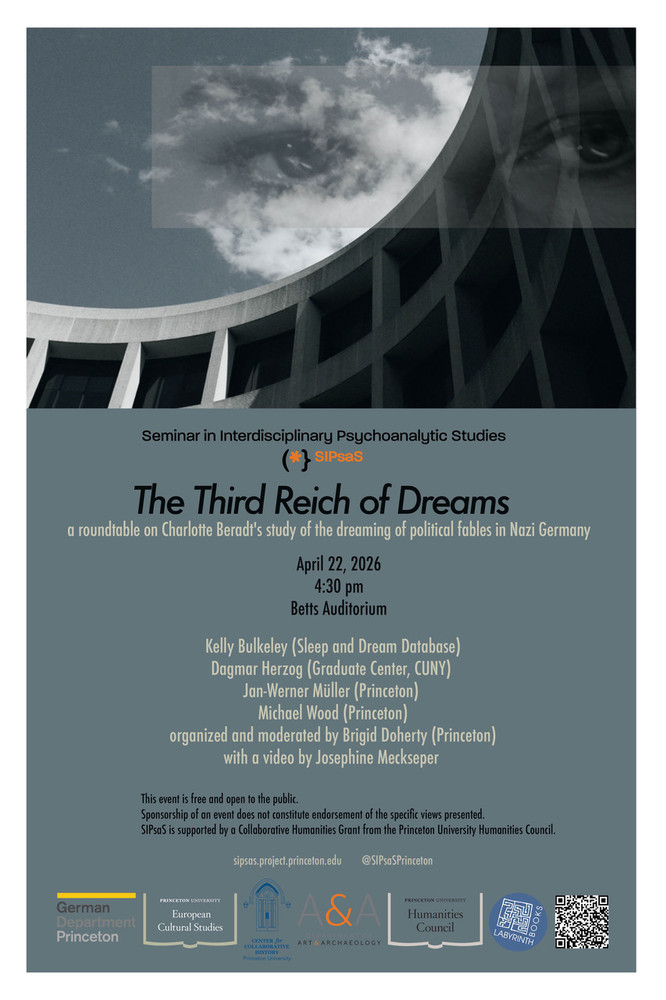
“The Third Reich of Dreams”: A roundtable on Charlotte Beradt’s study of the dreaming of political fables in Nazi Germany
Apr 22nd 2026
Events @ Princeton University
Weds 4/22 @ 4:30 PM
Betts Auditorium, Architecture Building, Princeton University
A roundtable on The Third Reich of Dreams, Charlotte Beradt's 1966 study of the dreaming of political fables in Nazi Germany, recently reissued by Princeton University Press in a new translation by Damion Searls. Please join us at 4:30 pm in Betts Auditorium, with a reception to follow.
Speakers: psychologist of religion and dream researcher Kelly Bulkeley, historian Dagmar Herzog, political theorist Jan-Werner Müller, and literary critic Michael Wood. The event will also feature a video by artist Josephine Meckseper. Moderated by Brigid Doherty.
Labyrinth Books will be on site with copies of The Third Reich of Dreams and works by the speakers for sale following the roundtable.
Free and open to the public.
Kelly Bulkeley is a psychologist of religion focusing on dreams. He is Director of the Sleep and Dream Database (SDDb) and the Dream Library Foundation and a Senior Editor of the APA journal Dreaming. His books include The Spirit of Dreaming in Shakespeare (in press), The Scribes of Sleep (2023), Lucrecia the Dreamer (2018), Big Dreams (2016), and Dreaming in the World’s Religions (2008). He lives in Estacada, Oregon.
Dagmar Herzog is Distinguished Professor of History at the Graduate Center, City University of New York. She is the author, most recently, of The New Fascist Body (Wirklichkeit Books 2025), the prizewinning The Question of Unworthy Life (Princeton 2024), as well as Cold War Freud (Cambridge 2017), Sexuality in Europe (Cambridge 2011), and Sex after Fascism (Princeton 2005). She teaches on the histories of Nazism and the Holocaust, sexuality and gender, disability rights and care politics, and is working on a new project – “Fascism’s Lingering” – based on a corpus of public opinion research conducted in post-Nazi Germany in the early 1950s.
Jan-Werner Müller teaches politics at Princeton, where he is also the founding director of the Forum for the History of Political Thought and the Academic Freedom Initiative. His books include Contesting Democracy: Political Ideas in Twentieth-Century Europe (2013) and A Dangerous Mind: Carl Schmitt in Post-War European Thought (2003). 2026 will see the publication of Street, Palace, Square: The Architecture of Democratic Spaces.
Michael Wood studied French and German at Cambridge University and was a fellow of St John’s College. He taught at Columbia, Exeter and Princeton, where he is now Professor Emeritus of English and Comparative Literature. He has written books on Stendhal, Nabokov, Yeats, and Hitchcock, and is the author, most recently, of On Empson (2017), The Habits of Distraction (2018), and Marcel Proust (2023). He writes regularly for the London Review of Books and the New York Review of Books.
Josephine Meckseper’s large-scale vitrine installations and films meld the aesthetic language of twentieth-century modernism with her own imagery of historical undercurrents. Her work has been featured in numerous solo museum exhibitions and biennials worldwide such as the Frac des Pays de la Loire, Nantes (2019) and the Whitney Biennial, New York (2006 and 2010). Meckseper’s works are held in major public collections, including the Whitney Museum of American Art, the Solomon R. Guggenheim Museum; the Museum of Modern Art, and the Metropolitan Museum, all in New York, where the artist lives and works. She received a Guggenheim Fellowship in 2022 and was also a Belknap Visiting Fellow in the Humanities Council and the Department of Art & Archaeology at Princeton that year.
Presented by Princeton University’s Seminar in Interdisciplinary Psychoanalytic Studies (SIPsaS). Co-sponsored by Princeton’s German Department, Center for Collaborative History, Department of Art & Archaeology, Program in European Cultural Studies, and Labyrinth Books.
Seminar in Interdisciplinary Psychoanalytic Studies (SIPsaS) is supported by a Collaborative Humanities Grant from the Humanities Council at Princeton University.
Sponsorship of an event does not constitute endorsement of the specific views presented.