Thursday 3/6 at 6:00PM
Labyrinth Books
122 Nassau Street
Â
How reading and writing are collective acts of political pedagogy, and why the struggle for change must begin at the level of the sentence.
"In The History of the Future, McPherson explores America in all its beauty and strangeness. He is funny and searching--a joy to read."--Elizabeth Kolbert Praise for Edward McPherson: "Mr. McPherson...
The classic debut collection from Pulitzer Prize winner James Alan McPhersonHue and Cry is the remarkably mature and agile debut story collection from James Alan McPherson, one of America’s most...
"An essential exploration of what's holding men and sports back--and how to overcome it." --Washington PostIn You Throw Like a Girl, former Syracuse University quarterback and NFL veteran Don...
With the same grace and lyrical precision that distinguish his vibrant short stories, James McPherson surveys the emotional upheaval of his last twenty-one years. From Baltimore, Maryland, to...
James M. McPherson is acclaimed as one of the finest historians writing today and a preeminent commentator on the Civil War. Battle Cry of Freedom, his Pulitzer Prize-winning account of that...
Student aid in higher education has recently become a hot-button issue. Parents trying to pay for their children's education, college administrators competing for students, and even President Bill...
More than 140 years ago, Mark Twain observed that the Civil War had "uprooted institutions that were centuries old, changed the politics of a people, transformed the social life of half the country,...
Fredric Jameson's essay "The Cultural Logic of Late Capitalism"--originally published in 1984 and later included in his canonical 1991 book Postmodernism, or, The Cultural Logic of Late...
Marking the two-hundredth anniversary of Lincoln's birth, this marvelous short biography by a leading historian offers an illuminating portrait of one of the giants in the American story.It is the...
More than 140 years ago, Mark Twain observed that the Civil War had "uprooted institutions that were centuries old, changed the politics of a people, transformed the social life of half the country,...
Fredric Jameson, in The Political Unconscious, opposes the view that literary creation can take place in isolation from its political context. He asserts the priority of the political interpretation...
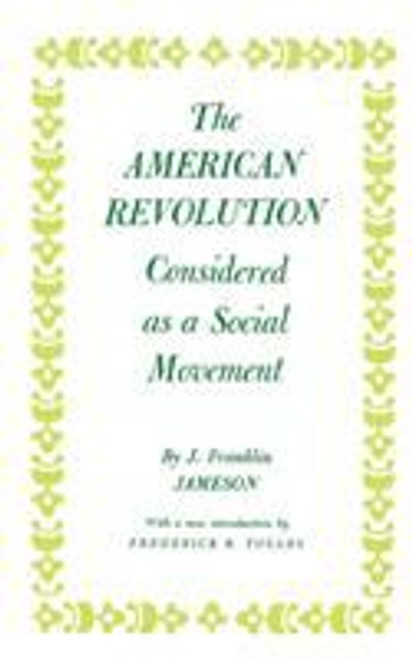
Written when political and military history dominated the discipline, J. Franklin Jameson's The American Revolution Considered as a Social Movement was a pioneering work. Based on a series of four...
In Battle Cry Of Freedom, James M. McPherson presented a fascinating, concise general history of the defining American conflict. With What They Fought For, he focuses his considerable talents on what...
James McPherson has emerged as one of America's finest historians. Battle Cry of Freedom, his Pulitzer Prize-winning account of the Civil War, was a national bestseller that Hugh Brogan, in The New...
The Battle of Antietam, fought on September 17, 1862, was the bloodiest single day in American history, with more than 6,000 soldiers killed--four times the number lost on D-Day, and twice the number...
Although previously undervalued for their strategic impact because they represented only a small percentage of total forces, the Union and Confederate navies were crucial to the outcome of the Civil...
Mimesis, Expression, Construction brings Fredric Jameson's famous Duke University seminar on Adorno’s Aesthetic Theory into print for the first time.Transcribed and edited from audio recordings taken...
History has not been kind to Jefferson Davis. His cause went down in disastrous defeat and left the South impoverished for generations. If that cause had succeeded, it would have torn the United...
In an age of globalization characterized by the dizzying technologies of the First World, and the social disintegration of the Third, is the concept of utopia still meaningful? Archaeologies of the...
The Battle of Antietam, fought on September 17, 1862, was the bloodiest single day in American history, with more than 6,000 soldiers killed--four times the number lost on D-Day, and twice the number...